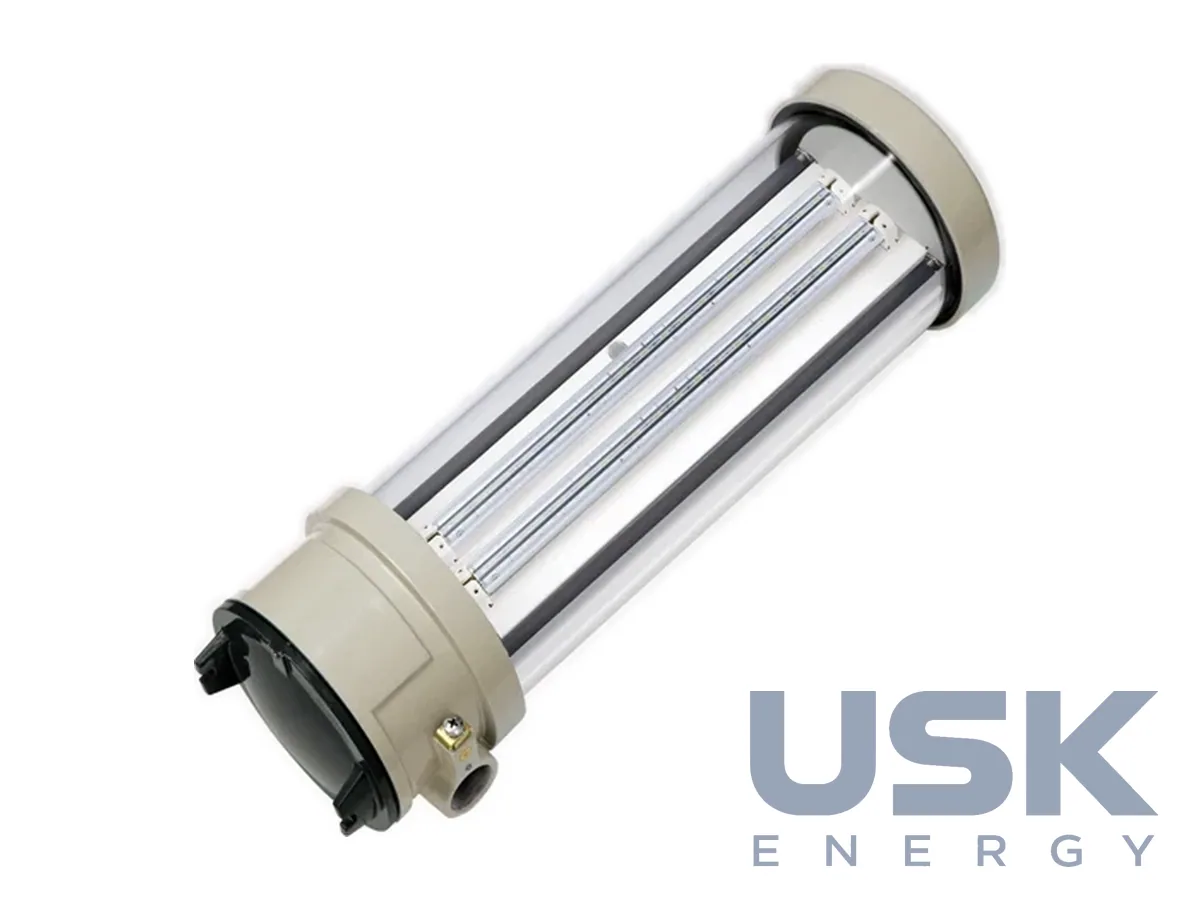
EXPLOSION-PROOF - explosion-proof emergency luminaire ATEX
Country: · Model: EXPLOSION-PROOF
EXPLOSION-PROOF is an emergency luminaire in an explosion-proof version marked II2G Ex d IIC T6 Gb and II2D Ex tb IIIC T85 °C Db under the ATEX directive. The aluminium body with borosilicate glass is intended for escape routes and workplaces where an explosive gas or dust atmosphere may form.
- Marking
- II2G Ex d IIC T6 Gb; II2D Ex tb IIIC T85 °C Db
- Body
- aluminium, borosilicate glass
- Directives
- 94/9/CE (ATEX), EMC
Technical specifications
| Marking | II2G Ex d IIC T6 Gb; II2D Ex tb IIIC T85 °C Db |
|---|---|
| Body | aluminium, borosilicate glass |
| Directives | 94/9/CE (ATEX), EMC |
Specifications are taken from the manufacturer’s technical documentation. Updated .
Description
An explosion-proof enclosure «d» is used for gas, and protection by enclosure «tb» for dust. The marking II2G Ex d IIC T6 Gb refers to gas atmospheres of subgroup IIC, the most severe, which covers hydrogen and acetylene, with temperature class T6 and protection level Gb. The marking II2D Ex tb IIIC T85 °C Db refers to conductive dust of group IIIC, where the maximum surface temperature is 85 °C, and the protection level is Db. Levels Gb and Db correspond to category 2 equipment, which is usually used in zones 1/2 for gas and 21/22 for dust. The manufacturer declares conformity with directives 94/9/CE (equipment for explosive atmospheres), 89/336/CE (electromagnetic compatibility) and 93/68/CE (CE marking). The luminaire is installed at oil and gas and chemical plants, in paint booths, battery rooms, warehouses of flammable materials, grain and flour milling plants and treatment facilities. The manufacturer has been designing emergency lighting since 1980.
How to choose
The choice depends on the atmosphere. For gas, in particular hydrogen and acetylene, marking with subgroup IIC and temperature class T6 is needed, and for conductive dust group IIIC with a surface temperature limit of 85 °C. The zone is determined by category 2, that is zones 1/2 and 21/22. Luminous flux, autonomy time, battery type and mounting method are not stated on the series page, so they are clarified from the technical sheet of the version. For ordinary rooms without explosion hazard NAOS for 90-440 lm is enough.
Request a price and lead time
EXPLOSION-PROOF - explosion-proof emergency luminaire ATEX. We reply within one business day.
Or email office@usk.ua or call +38 (044) 339-50-20.
FAQ
What does the marking II2G Ex d IIC T6 Gb mean?
Category 2 for a gas atmosphere, explosion-proof enclosure «d», subgroup IIC (hydrogen, acetylene), temperature class T6, protection level Gb.
For which zones is the EXPLOSION-PROOF emergency luminaire suitable?
Levels Gb and Db correspond to category 2 equipment, which is usually used in zones 1/2 for gas and 21/22 for dust.
What is the maximum surface temperature of the luminaire in a dust atmosphere?
By the marking II2D Ex tb IIIC T85 °C Db it is 85 °C, and dust is kept out by the enclosure «tb».
What material is the luminaire body made of?
The body is made of aluminium, and the light-transmitting element of borosilicate glass.
Which directives does the luminaire conform to?
The manufacturer declares 94/9/CE for equipment in explosive atmospheres, 89/336/CE for electromagnetic compatibility and 93/68/CE for CE marking.
Similar products
REQUEST
Need a price, lead time or replacement?
Send us a request and we will confirm the configuration, lead time and delivery terms. We reply by email.