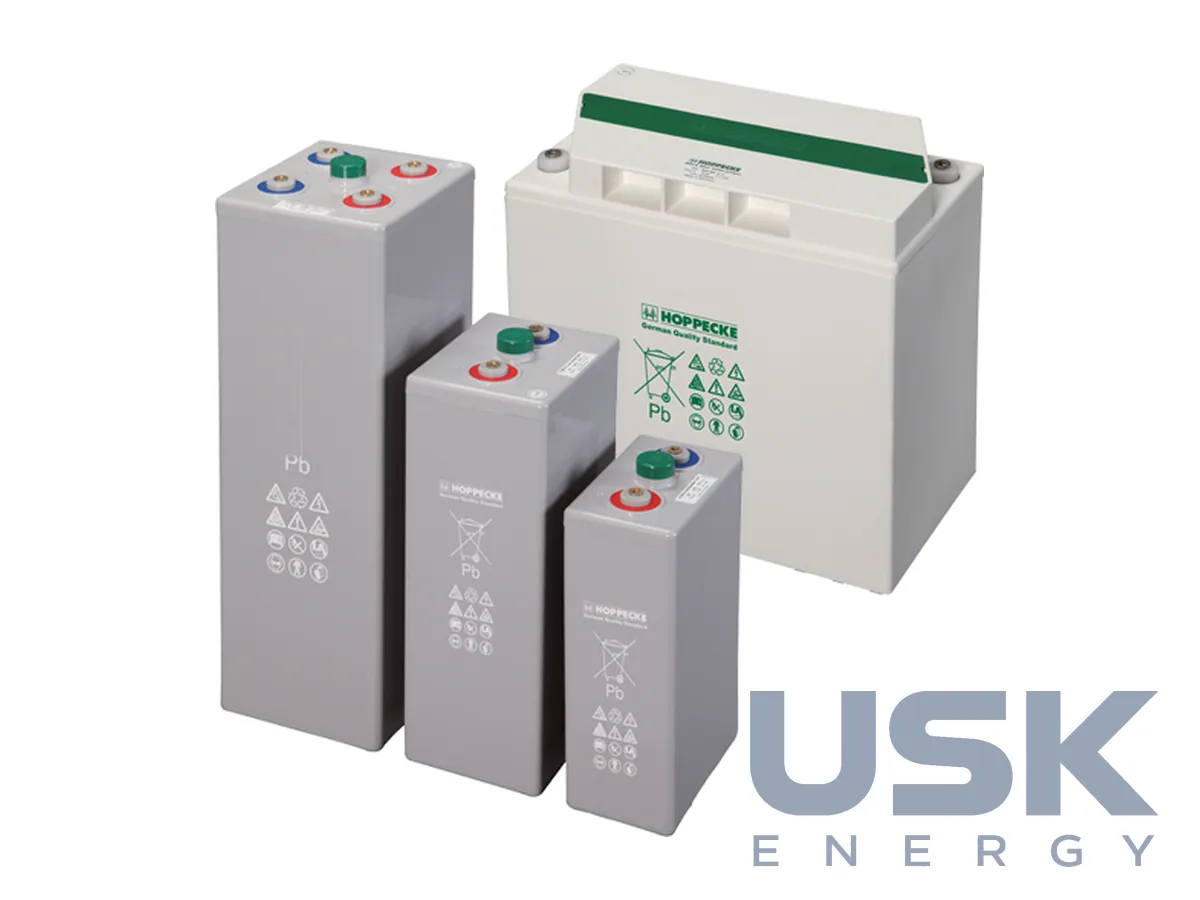
sun | power VR L — gel OPzV batteries for solar and hybrid systems
Country: Germany · Model: sun | power VR L
The gel OPzV batteries of the sun | power VR L series are supplied as 2 V cells and OPzV bloc monoblocks for cyclic operation with partial charge. Main applications include village power supply, hybrid systems, peak load smoothing and telecom base stations.
- Technology
- VRLA, gel electrolyte, tubular plates
- Design
- 2 V OPzV cells and OPzV bloc monoblocks
- Mode
- cycling at partial state of charge (PSoC)
- Standards
- IEC 60896-21/22, IEC 61427, DIN 40742
Technical specifications
| Technology | VRLA, gel electrolyte, tubular plates |
|---|---|
| Design | 2 V OPzV cells and OPzV bloc monoblocks |
| Mode | cycling at partial state of charge (PSoC) |
| Standards | IEC 60896-21/22, IEC 61427, DIN 40742 |
Specifications are taken from the manufacturer’s technical documentation. Updated .
Description
The positive electrodes are tubular, and the active mass is held in gauntlet tubes and does not shed during frequent cycles. The electrolyte is thickened into a gel, so the battery is sealed on the VRLA principle and works without adding water. The DIN 40742 standard defines the dimensions of stationary OPzV cells, which simplifies replacing old batteries in existing racks. The 2 V cells are connected in series to the inverter bus voltage, while OPzV bloc monoblocks are more convenient for small installations where a separate rack is not needed. PSoC mode is typical for off-grid solar plants, where the battery does not reach full charge for days. Compliance with IEC 61427 applies to batteries for renewable energy, while IEC 60896-21/22 describes tests of valve-regulated batteries.
How to choose
The choice between 2 V cells and OPzV bloc monoblocks depends on the system capacity. Large storage systems for villages and base stations are built from individual cells to reach the required capacity without parallel strings. If the battery mostly sits in standby in a UPS rather than cycling, the AGM series grid | Xtreme VR green series with a design life of 15 years or grid | power VR M with 2 V cells up to 1000 Ah are more suitable. For daily deep cycles at a solar plant, a gel OPzV is a better choice than AGM.
Request a price and lead time
sun | power VR L — gel OPzV batteries for solar and hybrid systems. We reply within one business day.
Or email office@usk.ua or call +38 (044) 339-50-20.
FAQ
How does a gel OPzV battery differ from AGM in a solar system?
Gel and tubular plates tolerate frequent cycles and PSoC partial charge better, while AGM series such as grid | power VR X with thin electrodes are intended for high short-discharge currents. The VR L series complies with IEC 61427.
Which voltages are available in the sun | power VR L series?
Individual 2 V OPzV cells and multi-cell OPzV bloc monoblocks are offered. The specific block ratings and capacities are given in the series datasheet.
Is ventilation needed for gel OPzV batteries?
In normal operation the gases recombine inside the cell, but the room is designed with ventilation according to the standards for lead-acid batteries. The series is tested to IEC 60896-21/22.
What does DIN 40742 mean in the OPzV specification?
It is the German standard for stationary gel OPzV cells with tubular plates, which defines their dimensions. As a result, sun | power VR L cells fit in place of analogues of the same format.
For which sites does the manufacturer recommend sun | power VR L?
For village power supply, hybrid systems, peak load smoothing and telecom base stations, where the battery works in a partial-charge cycle according to IEC 61427.
Similar products
REQUEST
Need a price, lead time or replacement?
Send us a request and we will confirm the configuration, lead time and delivery terms. We reply by email.