
SOLDERING: SOLDER, FLUXES, SOLDERING EQUIPMENT
LFM-23 S lead-free flux-cored solder wire
Country: Germany · Model: LFM-23 S
Lead-free solder wire with up to five times greater soldering tip durability compared with SAC305.
- Type
- Flux-cored wire
- Grades and article numbers
- LFM-23 S
Technical specifications
| Type | Flux-cored wire |
|---|---|
| Grades and article numbers | LFM-23 S |
Specifications are taken from the manufacturer’s technical documentation. Updated .
Description
This lead-free, silver-free flux-cored solder wire is designed to reduce costs in electronics manufacturing. Based on an SnCuNi alloy, it offers eutectic melting behaviour, significantly lower material costs and a soldering tip service life up to five times longer than with a conventional alloy. It suits applications where unit costs matter, including manual and robotic soldering iron processes where tip wear directly affects productivity.
The alloy composition is Sn-0.6Cu-0.05Ni-α-β, with solidus and liquidus both at 228 °C. The α and β additions form a patented micro-alloy that reduces oxidation and minimises iron erosion at the soldering tip. A soldering tip has a copper core coated with an iron layer that protects it from corrosion by the flux and from migration by the solder alloy. Because lead-free solder contains more than 95 % tin, it gradually dissolves this iron layer. Once the layer is consumed, the tip has reached the end of its life, which shows as holes forming in the copper core. The micro-alloy in LFM-23 S slows this dissolution. After 20,000 solder joints, iron erosion at the tip measured about 50 µm, compared with 250 µm for a conventional Sn-Cu-Ni reference alloy, or one fifth of the reference value.
For production, this mainly means fewer tip changes. In automated soldering systems the soldering tip is the consumable that sets the pace, and every change costs set-up time. Longer tip life therefore helps keep line operation efficient. Tip wear also depends on working temperature.
Because the alloy contains no silver, its metal content costs roughly half that of a SAC305 alloy such as LFM-48, which contains 3.0 % silver. Silver is the most expensive component of a classic SAC alloy. A silver-free alloy is also independent of the strongly fluctuating silver price, which makes material costs easier to plan. Combined with the up to fivefold tip life, LFM-23 S lowers two cost blocks at once: the solder itself and the consumables. For applications where maximum long-term strength under temperature cycling is the priority, the separate patented SJM series is available instead.
LFM-23 S flux-cored wire is available with the following fluxes: SR-LA Super (classification M1), GUMMIX 21 Zeta (classification L1) and NHR-TH (classification L0). This allows the flux activity to be matched to the requirements of the respective soldering task.
Similar products
 Trilence 35003500 flux-cored solder wire
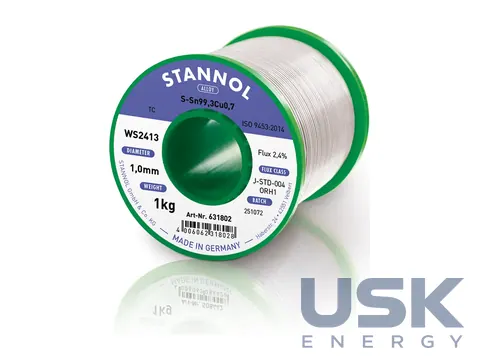 WS2413WS2413 flux-cored solder wire
 Свинецсодержащие и легкоплавкие сплавы (Sn63Pb37, Pb96Sn2Ag2Sn63Pb37, Pb96Sn2Ag2, Bi57Sn43, SnBi28 leaded and low-melting solder alloysФлюсы REGI для волновой пайки (GOLD, RED, GREEN, BLUE)REGI-GOLD/RED/GREEN/BLUE wave soldering fluxes
Request a price and lead time
LFM-23 S lead-free flux-cored solder wire. We reply within one business day.
Or email office@usk.ua or call +38 (044) 339-50-20.
REQUEST
Need a price, lead time or replacement?
Send us a request and we will confirm the configuration, lead time and delivery terms. We reply by email.