


SOLDERING: SOLDER, FLUXES, SOLDERING EQUIPMENT
SJM-03 flux-cored solder wire
Country: Germany · Model: SJM
High-strength alloys designed for reliable solder joints and a stable soldering process.
- Type
- flux-cored wire
- Grades and article numbers
- SJM-03
Technical specifications
| Type | flux-cored wire |
|---|---|
| Grades and article numbers | SJM-03 |
Specifications are taken from the manufacturer’s technical documentation. Updated .
Description
Lead-free flux-cored solder wire from the SJM series, developed to give lead-free joints the strength associated with leaded solders. SJM stands for "Strong Joint Metal" and refers to high-strength alloys that do not crack as the solder joint ages. SJM-03 is a patented alloy with the composition Sn-0.3Ag-0.7Cu-2.0Bi and a melting range of 210–225 °C. Its low silver content of only 0.3%, compared with 3.0% in SAC 305, gives higher joint strength than standard alloys at a lower material cost driven by the silver surcharge.
Commonly used lead-free alloys show cracks after about 500 thermal cycles. SJM-03 remains intact and crack-free after 1,500 cycles. Its initial strength is 6% higher than that of the widely used SAC 305 alloy, and after 2,000 thermal cycles its strength is up to 35% higher.
In a comparison test, solder joint strength was measured in newtons on a 1206 component cycled between −40 °C and +85 °C with a 30-minute dwell time. SJM-03 measured 69.8 N initially, then 69.5 N at 500 cycles, 76.0 N at 800, 77.5 N at 1,000, 79.5 N at 1,500 and 72.0 N at 2,000 cycles. Under the same conditions, SAC 305 measured 66.8, 67.0, 67.8, 66.0, 63.8 and 57.0 N. SACX 0307 measured 62.5, 59.5, 58.5, 57.0, 58.7 and 42.0 N.
The series uses a patented micro-alloying concept, and the exact proportions of the additional elements are not published. Each added element has a specific role. Bismuth (Bi) increases tensile and tear strength and improves long-term reliability. Iron (Fe) minimizes soldering tip wear. Antimony (Sb) further increases long-term reliability. Gallium (Ga) prevents oxidation. The series is described as defence-approved, and its silver content can be selected from 0.3% to 4%.
The SJM series, available as solder wires and solder pastes, includes the following alloys: SJM-03: Sn-0.3Ag-0.7Cu-2.0Bi, 210–225 °C, standard range. SJM-03 S: Sn-0.3Ag-0.7Cu-2.0Bi-α, 210–226 °C, standard range. The α denotes the unpublished patented micro-alloy. SJM-10: Sn-1.0Ag-0.7Cu-2.0Bi, 212–224 °C, standard range. SJM-30: Sn-3.0Ag-2.0Bi-1.0Sb, 216–224 °C, on request. SJM-35: Sn-3.5Ag-2.0Bi, 216–220 °C, on request. SJM-40: Sn-4.0Ag-2.0Bi-3.0Sb, 221–227 °C, standard range.
SJM-40 is the high-performance variant, patented under JP PAT No. 3045453. It combines bismuth and antimony with a higher silver content and shows no cracking after 2,000 thermal cycles between −40 °C and +80 °C, whereas a standard SAC alloy has in most cases fractured completely in the same test. It retains its strength under severe temperature changes and is intended for joints that must withstand changing temperatures for years where leaded wire is no longer an option, such as automotive electronics, medical technology, aerospace and defence applications.
Similar products
 Trilence 35003500 flux-cored solder wire
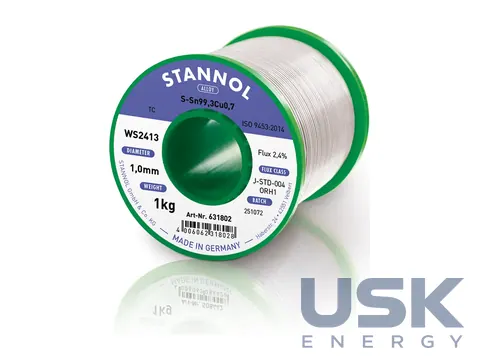 WS2413WS2413 flux-cored solder wire
 Свинецсодержащие и легкоплавкие сплавы (Sn63Pb37, Pb96Sn2Ag2Sn63Pb37, Pb96Sn2Ag2, Bi57Sn43, SnBi28 leaded and low-melting solder alloysФлюсы REGI для волновой пайки (GOLD, RED, GREEN, BLUE)REGI-GOLD/RED/GREEN/BLUE wave soldering fluxes
Request a price and lead time
SJM-03 flux-cored solder wire. We reply within one business day.
Or email office@usk.ua or call +38 (044) 339-50-20.
REQUEST
Need a price, lead time or replacement?
Send us a request and we will confirm the configuration, lead time and delivery terms. We reply by email.