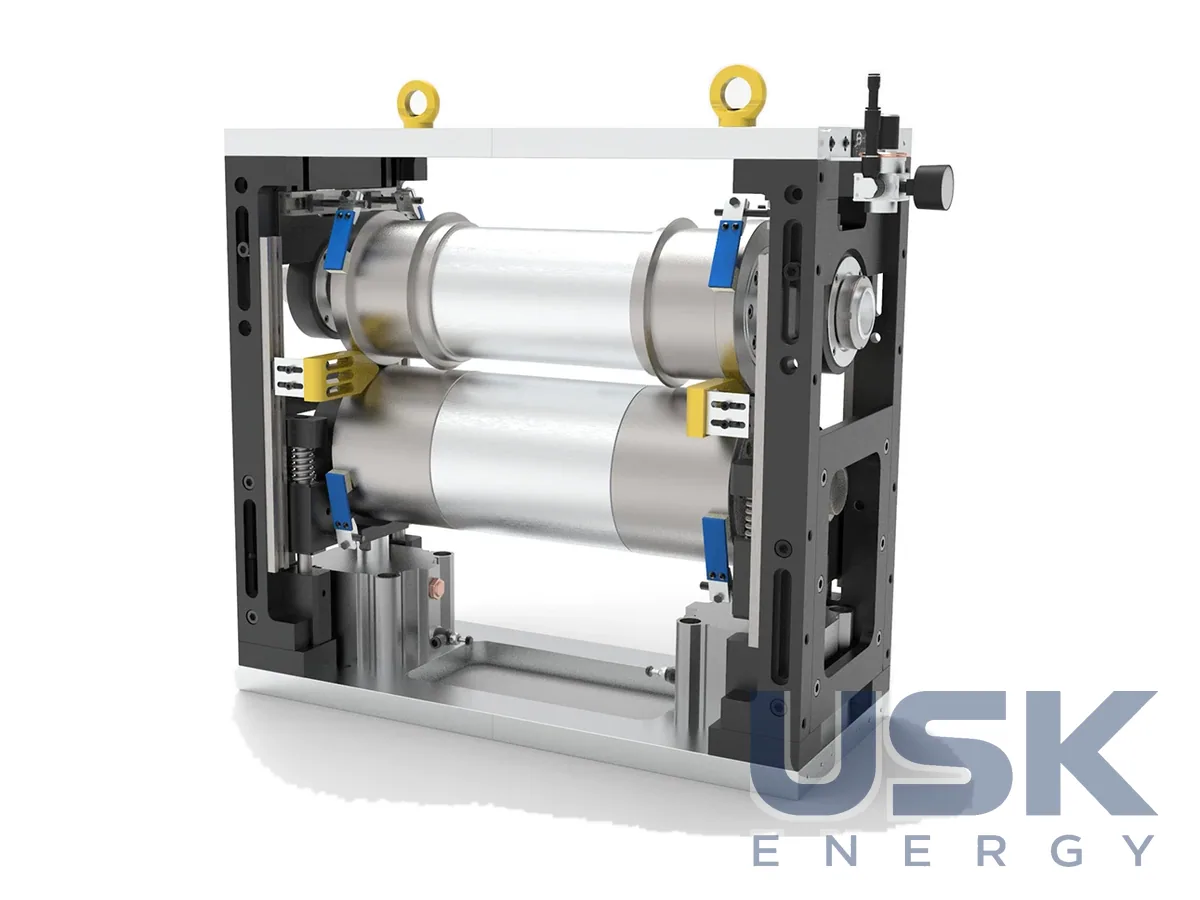
Die cutting solutions for electric vehicle batteries
Country: · Model: Rotary die tooling
Rotary die tooling for electric vehicle batteries and fuel cells is aimed at series production of intricate parts. Precision and high throughput come first here, and the cost per part has to stay acceptable.
Technical specifications
Specifications are taken from the manufacturer’s technical documentation. Updated .
Description
Demand for electric vehicles and fuel cell technology is growing, so manufacturers must turn out intricate battery and fuel cell components in large series. Such parts have a fine outline, and every deviation in size shows up when the assembly is put together. Rotary die tooling forms the outline between two rolls continuously and not in separate strokes, so throughput keeps pace with the line. Scalability means output can grow with demand by adding lines and not by changing the technology. Production economy depends on throughput and tool life, so these two figures are compared before a series starts. That is why the rotary principle becomes the main one for clean energy, where volumes climb fast.
How to choose
Rotary die tooling is chosen when series are large and the part geometry is intricate and tightly set. Before ordering, agree on the outline, the blank material and the required output. For small batches and prototypes such tooling rarely pays off.
Request a price and lead time
Die cutting solutions for electric vehicle batteries. We reply within one business day.
Or email office@usk.ua or call +38 (044) 339-50-20.
FAQ
Which electric vehicle parts are made with rotary die tooling?
Intricate battery and fuel cell components made in large series. Precision and process efficiency matter most there.
Why do batteries call for high die-cut precision?
The parts have an intricate outline, and a size error affects assembly. So precision is placed next to throughput.
What does scalable output mean for rotary die tooling?
The process can grow in line with demand. That matters for the electric vehicle and clean energy market.
Is rotary die tooling suitable for fuel cells?
Yes, it is used for fuel cell components and for battery parts alike. Both markets are growing.
Similar products
 DIN 471 / 472 / 912 / 933 / 981 / 6885Slotted nuts, retaining rings, pins, keys, screws (DIN 471/472/912/933/981/6885, ISO 2338)
 AE-T100NG / AE-T100BMicroturbine cogeneration units 100–105 kW
 KT / ZT-CKEmergency diesel generator sets in cabinet design, 200–440 V, 20–875 kVA
 Shielded anechoic / EMC chambersTurnkey shielded anechoic and EMC chambers (pre-scan, 3 m, 10 m, MIL-STD, CISPR 25, antenna, compact ranges), 26 MHz … 40 GHz, shielding 100 dB
REQUEST
Need a price, lead time or replacement?
Send us a request and we will confirm the configuration, lead time and delivery terms. We reply by email.