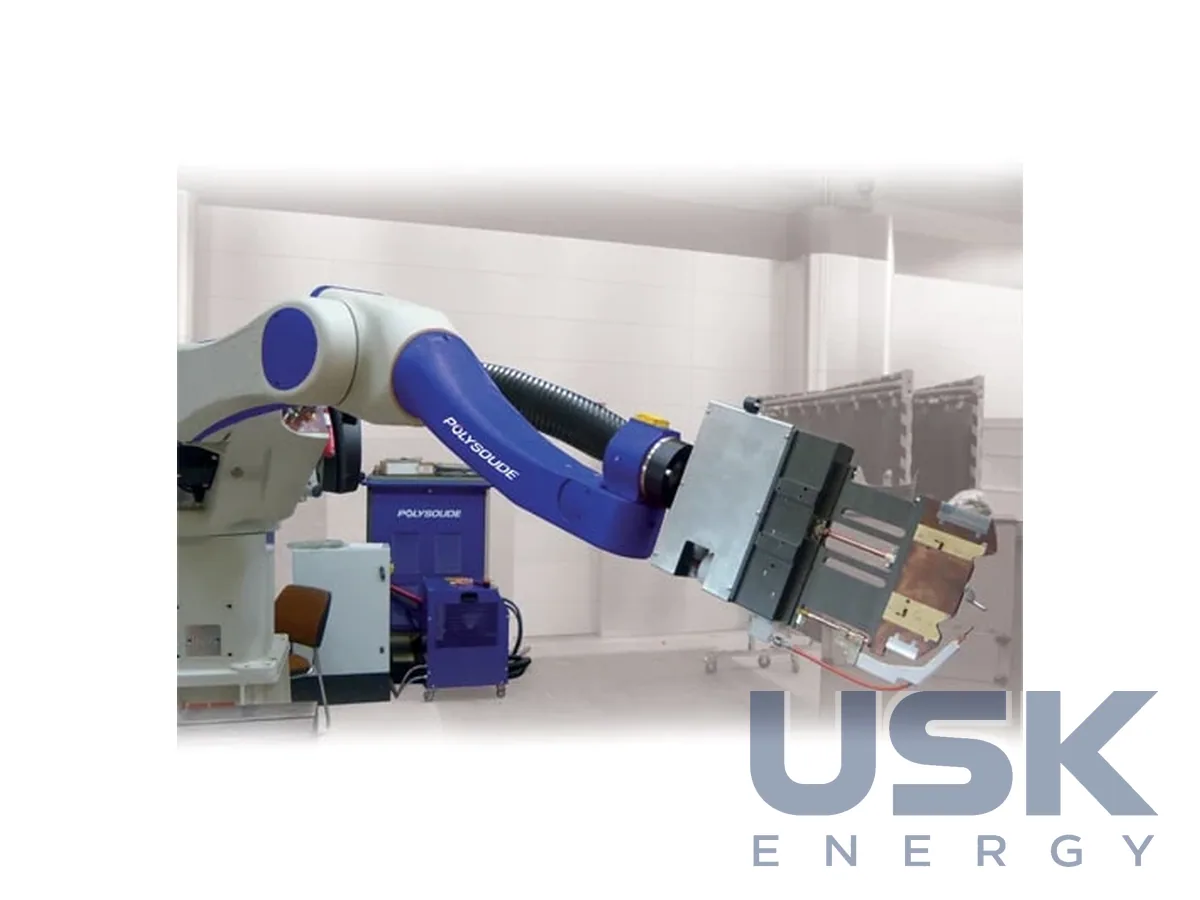
Robotic TIG/plasma welding cells
Country: · Model: Robotic TIG/plasma cell
The robotic cell welds with a non-consumable electrode (TIG) with cold or hot wire, and also with plasma. An industrial robot is used where the weld has a complex geometry that an orbital head or a linear unit cannot reach. The cells are installed in aerospace, power, chemical and food industries.
- Processes
- TIG CW/HW, plasma
- Composition
- robot, torch, positioner, peripherals, controller
Technical specifications
| Processes | TIG CW/HW, plasma |
|---|---|
| Composition | robot, torch, positioner, peripherals, controller |
Specifications are taken from the manufacturer’s technical documentation. Updated .
Description
The cell is built around an industrial robot carrying TIG, plasma or narrow-gap torches, a wire feed mechanism and, if needed, video cameras and weld tracking systems. The workpiece is placed on a positioner, rotary table or rotator, and through the controller they are synchronized with the robot and the welding current. The parameters are set by P6 or PC series power sources with an interface for mechanized and robotic peripherals. Programs are prepared in advance, and the welding data are recorded to document quality. In one cell the robot can perform several tasks. A separate version of the cell is made for tubes with tubesheets, with laser positioning and offline programming.
How to choose
The robot model and working area are defined by the project and are not given in the sources, so the cell is ordered for a specific part. If the weld is straight or circumferential, it is simpler to use an orbital head or a linear unit. A robot is taken for parts that cannot be welded by either of these methods. For tube-to-tubesheet joints there is a separate robotic version.
Request a price and lead time
Robotic TIG/plasma welding cells. We reply within one business day.
Or email office@usk.ua or call +38 (044) 339-50-20.
FAQ
Which welds need a robotic cell?
Welds of the most complex geometry that cannot be made with an orbital head or a linear unit.
Which welding processes does the cell support?
TIG with cold or hot wire and plasma welding.
What does the robotic cell consist of?
An industrial robot, a welding torch, a positioner or rotator, a wire feed mechanism and a controller. Video cameras and weld tracking are added on top of this.
How are the workpiece, robot and current synchronized?
Positioners, rotary tables and rotators work through the controller, which synchronizes them with the robot and the welding current.
Similar products
 Fortis 270 / 320 / 400 / 500MIG/MAG welding power source 270–500 A (multiprocess)
 TPS/i (270i C, 320i C, 320i, 400i, 500i, 600i)MIG/MAG welding system 270–600 A
 iQ 1500 / iQ 3000 / iQ 4500iQ 1500 / iQ 3000 / iQ 4500 high-precision plasma systems 20–450 A for CNC cutting
 Smart Focus 130 / 200 / 300 / 400Smart Focus 130 / 200 / 300 / 400 plasma systems 35–400 A for machine cutting
REQUEST
Need a price, lead time or replacement?
Send us a request and we will confirm the configuration, lead time and delivery terms. We reply by email.