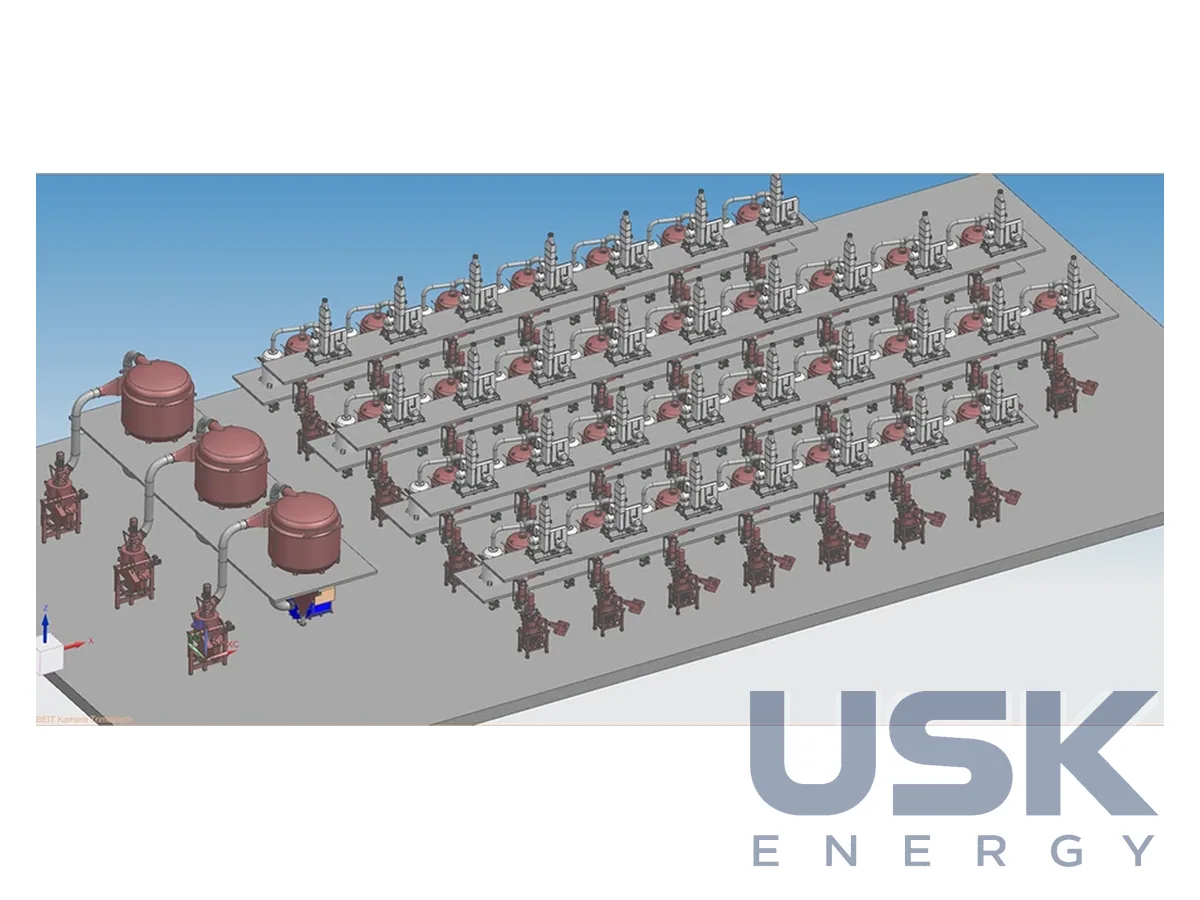
NEA|Sphere M / S / C — line for grinding, spheronizing and fractionating anode graphite for batteries
Country: · Model: NEA|Sphere M / S / C
NEA|Sphere M, S and C is a set for producing spherical anode graphite for lithium-ion batteries, which separates grinding, spheronizing and fractionating into individual stages. Instead of a sequential chain of 20–30 impact classifier mills, each stage is adjusted separately. The typical fineness requirement for batteries is 90 % of particles smaller than 10–40 µm.
- Composition
- NEA|Sphere M — grinding; NEA|Sphere S — spheronizing (rounding); NEA|Sphere C — fractionating based on the GRC classifier
- Versions
- index n — natural flake graphite; index s — synthetic graphite and petroleum coke
- Tap density
- natural graphite — up to over 1 g/ml; petroleum coke for synthetic graphite — 0.7–0.9 g/ml
- Comparison with the traditional scheme
- instead of a sequential chain of 20–30 impact classifier mills — separate stages of grinding, classification and spheronizing
Technical specifications
| Composition | NEA|Sphere M — grinding; NEA|Sphere S — spheronizing (rounding); NEA|Sphere C — fractionating based on the GRC classifier |
|---|---|
| Versions | index n — natural flake graphite; index s — synthetic graphite and petroleum coke |
| Tap density | natural graphite — up to over 1 g/ml; petroleum coke for synthetic graphite — 0.7–0.9 g/ml |
| Comparison with the traditional scheme | instead of a sequential chain of 20–30 impact classifier mills — separate stages of grinding, classification and spheronizing |
| Goal | steep particle distribution, minimum ultrafine fraction, narrow d90/d10 ratio, high yield |
| Related equipment (brochure) | ICS spheronizing mill, tap density over 1000 g/l, yield 70–85 %; with combined grinding and rounding, losses of up to 70 % of the raw material |
| Typical fineness for batteries | 90 % < 10–40 µm |
| Applications | anode graphite for lithium-ion batteries, raw material for fuel cells (petroleum coke, graphite, silicon) |
Specifications are taken from the manufacturer’s technical documentation. Updated .
Description
Unit M grinds with high-intensity tools and a built-in classifier to the required fineness without overgrinding. Unit S fully spheronizes the particles in one pass with a built-in classification module, which raises the rounding yield. Unit C, based on GRC, fractionates, in particular flaky products, when a narrow d90/d10 ratio is required. Each unit comes in two variants, with index n for natural flake graphite and s for synthetic graphite and its starting materials. Natural graphite is rounded to a tap density of over 1 g/ml, while petroleum coke as a starting material for synthetic graphite allows 0.7–0.9 g/ml.
How to choose
The composition of the set depends on the raw material. For synthetic graphite and petroleum coke, Ms and Ss are usually sufficient, fine natural graphites are produced on Mn and Sn, and for coarser natural anode graphite Cn is added. According to the manufacturer's brochure, with combined grinding and rounding, losses can reach 70 % of the raw material, while a separate scheme with the ICS spheronizing mill gives a tap density of over 1000 g/l and a yield of 70–85 %. The set is supplied under an individual concept that takes into account the raw material, the required quality and the production capacity.
Request a price and lead time
NEA|Sphere M / S / C — line for grinding, spheronizing and fractionating anode graphite for batteries. We reply within one business day.
Or email office@usk.ua or call +38 (044) 339-50-20.
FAQ
Why separate grinding and spheronizing into individual stages?
In the traditional chain of 20–30 impact classifier mills, grinding, classification and rounding take place at the same time and cannot be adjusted separately. Separation gives a steep particle distribution, a minimum of ultrafine fraction and a higher yield.
How does index n differ from s?
Index n means natural flake graphite, index s means synthetic graphite and petroleum coke.
What fineness is needed for battery graphite?
The typical requirement is 90 % of particles smaller than 10–40 µm. The ultrafine fraction, which degrades the battery, has to be removed, so it is minimized.
What is the tap density of natural graphite?
Natural graphite is rounded to over 1 g/ml, while petroleum coke for synthetic graphite allows 0.7–0.9 g/ml.
REQUEST
Need a price, lead time or replacement?
Send us a request and we will confirm the configuration, lead time and delivery terms. We reply by email.