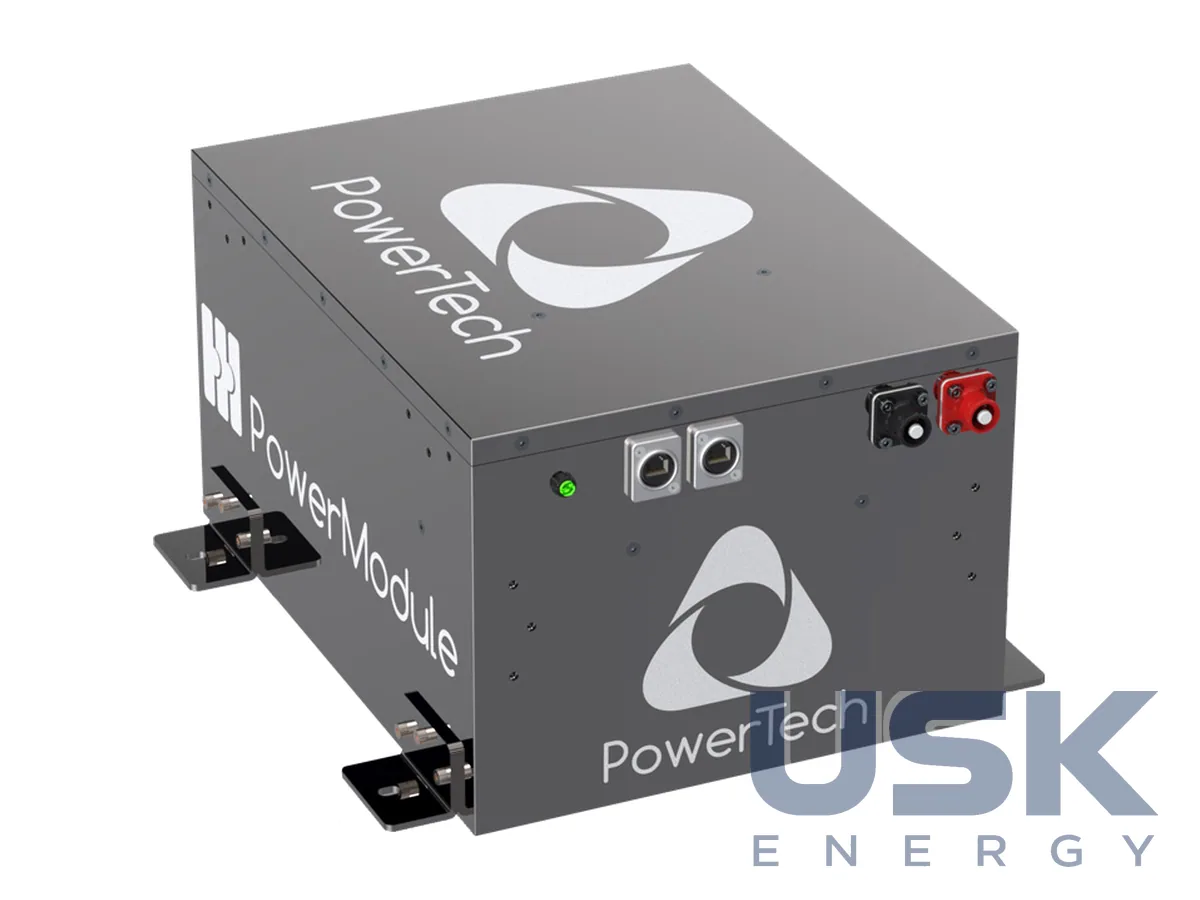
POWERMODULE 48V 5.4 KWH MODULAR LIFEPO4 BATTERIES
PowerModule v2 51.2V 105Ah (5.4 kWh) modular LiFePO4 battery
Country: France · Model: PowerModule v2
A 51.2 V / 105 Ah LiFePO4 module with 5.376 kWh, the building block for systems of up to 819.2 V and 688 kWh. It delivers 125 A (6.4 kW) continuously and a 250 A peak for 30 s. Sealed cells sit in a stainless steel housing with a heated BMS Matrix.
- Voltage
- 51.2 V
- Capacity
- 105 Ah
- Energy
- 5,376 Wh
- Cycle life
- >3000
- Protection
- IP54
- Weight
- 43.5 kg
- Dimensions
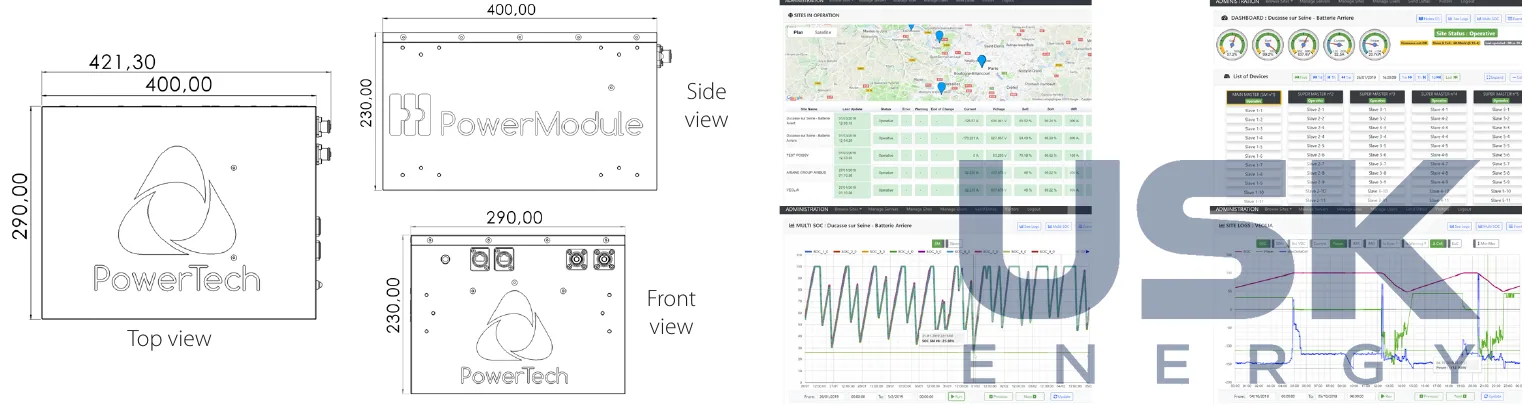
- 400 × 290 × 230
Technical specifications
| PowerModule unit | |
|---|---|
| Min / nominal / max voltage | 48.0 V / 51.2 V / 58.4 V |
| Nominal capacity (at 1C, 25 °C) | 105 Ah (5.376 kWh) |
| Weight (± 3%) | 43.5 kg |
| Dimensions (L × W × H) | 400 × 290 × 230 mm |
| Operating temperature | −20 °C to +60 °C |
| Protection index | IP54 (IP65 on request) |
| Power connector | Amphenol Powerlok IP67 |
| Specific energy | 123.5 Wh/kg |
| Energy density | 201.5 Wh/L |
| Continuous discharge current (at 20 °C) | 125 A (6.40 kW) |
| Peak discharge current (10 min / 30 s) | 200 A (10.24 kW) / 250 A (12.80 kW) |
| Recommended charge voltage | 57.0 V (max 58.4 V) |
| Float charge voltage | 53.4 V |
| Standard charge current | 50 A (2.56 kW) |
| Fast charge current | 100 A (5.12 kW) |
| PowerModule assembly | |
| Nominal voltage | from 51.2 V up to 819.2 V (16S) |
| Nominal capacity (at 1C, 25 °C) | up to 688 kWh (128 modules) |
| Serial assembly | up to 16 modules in series (819.2 V nominal) |
| Parallel assembly | up to 128 modules in parallel (51.2 V nominal) |
| Series-parallel configurations | |
| 2S (102.4 V) | up to 64 strings in parallel (P) |
| 3S (153.6 V) | up to 42P |
| 4S (204.8 V) | up to 32P |
| 5S (256.0 V) | up to 25P |
| 6S (307.2 V) | up to 21P |
| 7S (358.4 V) | up to 18P |
| 8S (409.6 V) | up to 16P |
| 9S (460.8 V) | up to 14P |
| 10S (512.0 V) | up to 12P |
| 11S (563.2 V) | up to 11P |
| 12S (614.4 V) | up to 10P |
| 13S (665.6 V) & 14S (716.8 V) | up to 9P |
| 15S (768.0 V) & 16S (819.2 V) | up to 8P |
| BMS Matrix technology | |
| Monitoring of each module | current, power, voltage, PCB temperature, cell voltage and temperature, state of charge (SOC), state of health (SoH), contactor states, etc. |
| Alerts and status | real-time communication of alerts, warnings and status messages to external devices over CAN 2B bus |
| Intra- and inter-module balancing | cell balancing within each module and between all modules in a system |
| Automatic cut-off | triggered by alert events (over-current, over-charge, over-temperature, etc.) or manually by CAN message |
| Cell heating | heating system management, operation down to −25 °C |
| Inter-module communication | private, secure bus; distributed architecture with high fault tolerance |
| Certification | |
| Certifications | CE, UN 38.3, IEC 62619, IEC 62620 |
| Marine approval | Bureau Veritas Type Approval for steel ships: BATTERY SYSTEMS, UMS, CCS, PORT, IMS |
| Customs codes (for reference) | |
| HS code | 8507.60 |
| UKTZED code (Ukraine) | 8507600000 |
| CN code (EU) | 85076000 |
Specifications, charts and drawings are taken from the manufacturer’s technical documentation. Updated . Customs codes are for reference only; the final code is determined at customs declaration for the specific model.
Description
Module voltage runs from 48.0 V to 58.4 V, it weighs 43.5 kg, measures 400 × 290 × 230 mm and stores 123.5 Wh/kg and 201.5 Wh/L. Power goes through an Amphenol Powerlok IP67 connector, and the housing is IP54, IP65 on request. Beyond the 30 s peak, the module holds 200 A (10.24 kW) for 10 minutes, enough for acceleration or lifting on a traction machine. BMS Matrix tracks current, voltage, cell temperature, SOC and SoH in each module, sends alarms over CAN 2B and opens the contactors on overcurrent, overcharge or overheating. Cells are balanced inside each module and across modules, and heating supports operation down to −25 °C.
How to choose
Design the layout from the inverter or traction bus voltage. An 8S string gives 409.6 V with up to 16 strings in parallel, 16S gives 819.2 V with up to 8P, and on a 48 V bus modules go in parallel only, up to 128. For more current, IP67 and solid-state cells, look at the PowerModule Solid State.
Features
- Plug-and-play, quick commissioning
- Up to 128 modules in series and parallel
- Real-time cloud monitoring
- Stainless steel housing, IP54 (IP65 on request)
- Amphenol IP67 connector
- External CAN bus link
- Long service and cycle life
- BMS Matrix heating, runs down to −25 °C
- Private bus between modules, distributed design
Applications
Certifications
Request a price and lead time
PowerModule v2 51.2V 105Ah (5.4 kWh) modular LiFePO4 battery. We reply within one business day.
Or email office@usk.ua or call +38 (044) 339-50-20.
FAQ
How many PowerModule v2 units can be connected in series and parallel?
Up to 16 in series (819.2 V nominal) and up to 128 in parallel (51.2 V). An 8S string at 409.6 V takes up to 16 strings in parallel.
What voltage and current charge the PowerModule v2?
Recommended charge voltage is 57.0 V (58.4 V max), float 53.4 V. Standard current is 50 A (2.56 kW), fast charge 100 A (5.12 kW).
What certifications does the PowerModule v2 hold?
CE, UN 38.3, IEC 62619 and IEC 62620, plus Bureau Veritas Type Approval for steel ships.
Is the PowerModule v2 suitable for ships?
Yes, the Bureau Veritas approval carries the BATTERY SYSTEMS, UMS, CCS, PORT and IMS notations.
Similar products
REQUEST
Need a price, lead time or replacement?
Send us a request and we will confirm the configuration, lead time and delivery terms. We reply by email.