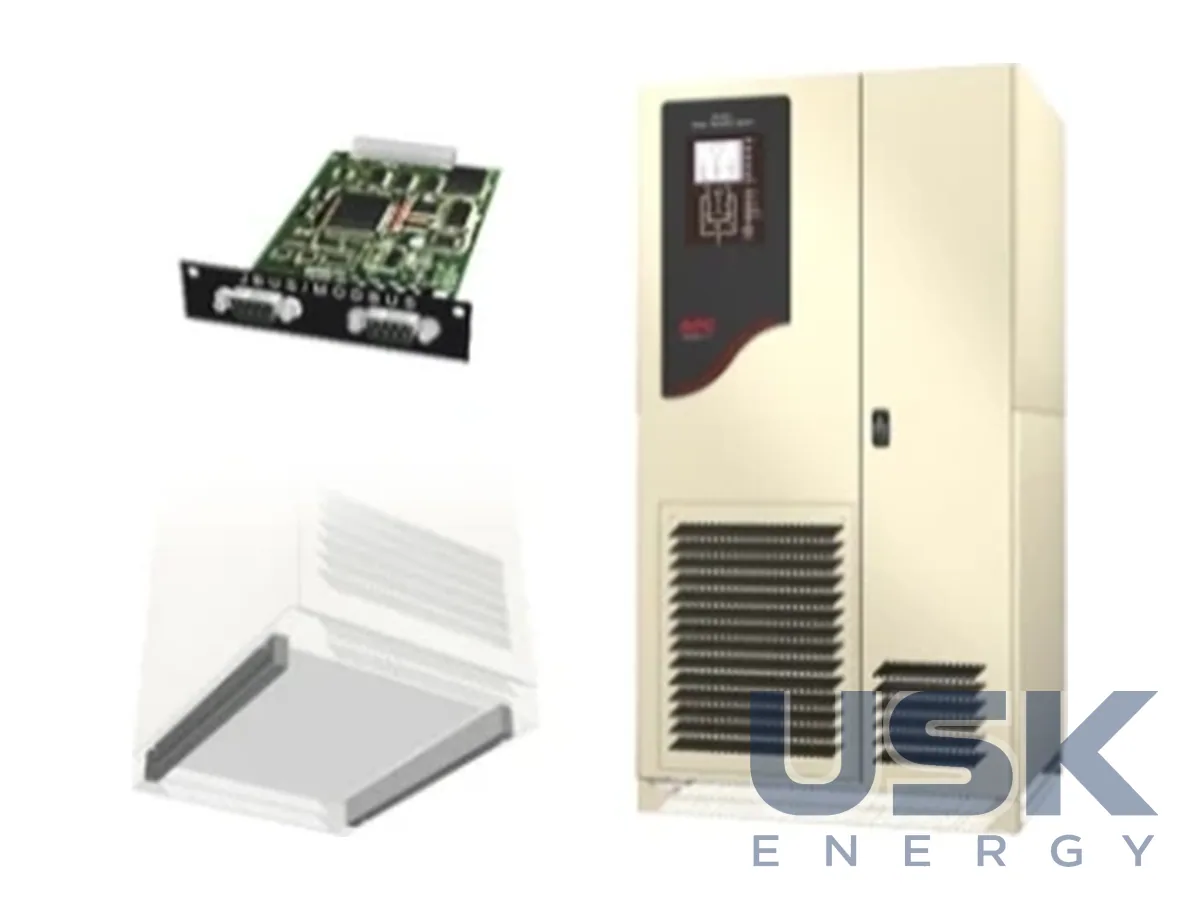
Static Transfer Switches (STS) — static transfer switches
Country: France · Model: STS
STS static transfer switches move a critical load from one power source to another in less than 4 ms. They are installed between two independent feeds, for example two UPS units or a UPS and the mains, so that servers, telecom and control systems with a single power input do not notice a failure at the source.
- Transfer time
- < 4 ms
- Purpose
- supplying the load from two independent sources
Technical specifications
| Transfer time | < 4 ms |
|---|---|
| Purpose | supplying the load from two independent sources |
Specifications are taken from the manufacturer’s technical documentation. Updated .
Description
Switching is done by power semiconductor switches, so there is no mechanical contact travel and no arc in the circuit, and the pause consists only of the time to detect the failure and switch the semiconductors. The control unit continuously monitors the voltage of the main source and, if it disappears or goes out of tolerance, transfers the load to the standby source without staff involvement. An interval of less than 4 ms is shorter than half a mains voltage cycle, so the power supplies of IT equipment and controllers usually ride through it without restarting. Both sources must be truly independent, that is, fed from different lines, transformers or generator sets, otherwise one failure will de-energize both inputs of the switch. The switch is placed closer to the consumers, after the uninterruptible power sources, and then it covers both a failure of the UPS itself and damage to the cables and boards between it and the load.
How to choose
A static transfer switch is needed where the consumer has a single power input and cannot tolerate a pause longer than a few milliseconds. The version is selected by load current with a margin for inrush currents and by the number of phases, and these data are specified for a particular switchboard. If a short break is acceptable and the feeds are rated for up to 1600 A and up to 690 V, the mechanical TransferPacT transfer switch with manual, remote or automatic control is more suitable.
Request a price and lead time
Static Transfer Switches (STS) — static transfer switches. We reply within one business day.
Or email office@usk.ua or call +38 (044) 339-50-20.
FAQ
What is the transfer time of the STS static transfer switch?
Less than 4 ms from detecting the failure to supply from the standby feed. Mechanical transfer switches take noticeably longer, because the contacts need time to travel.
How does a static switch differ from a contactor-based ATS?
In an STS the current is switched by semiconductor switches without an arc or mechanical travel, so the pause is under 4 ms. A contactor or motor-driven ATS switches with a longer break, which servers and controllers already notice.
Do the sources at the STS inputs need to be synchronized?
Yes, for switching without a current surge it is desirable to keep the voltages of both feeds in phase. For this reason the UPS units feeding the switch inputs are usually synchronized with each other.
Is an STS needed for servers with two power supplies?
A server with two power supplies is connected to two independent buses directly and does not need a switch. An STS is installed for equipment with a single input, which otherwise depends on one source.
Similar products
REQUEST
Need a price, lead time or replacement?
Send us a request and we will confirm the configuration, lead time and delivery terms. We reply by email.