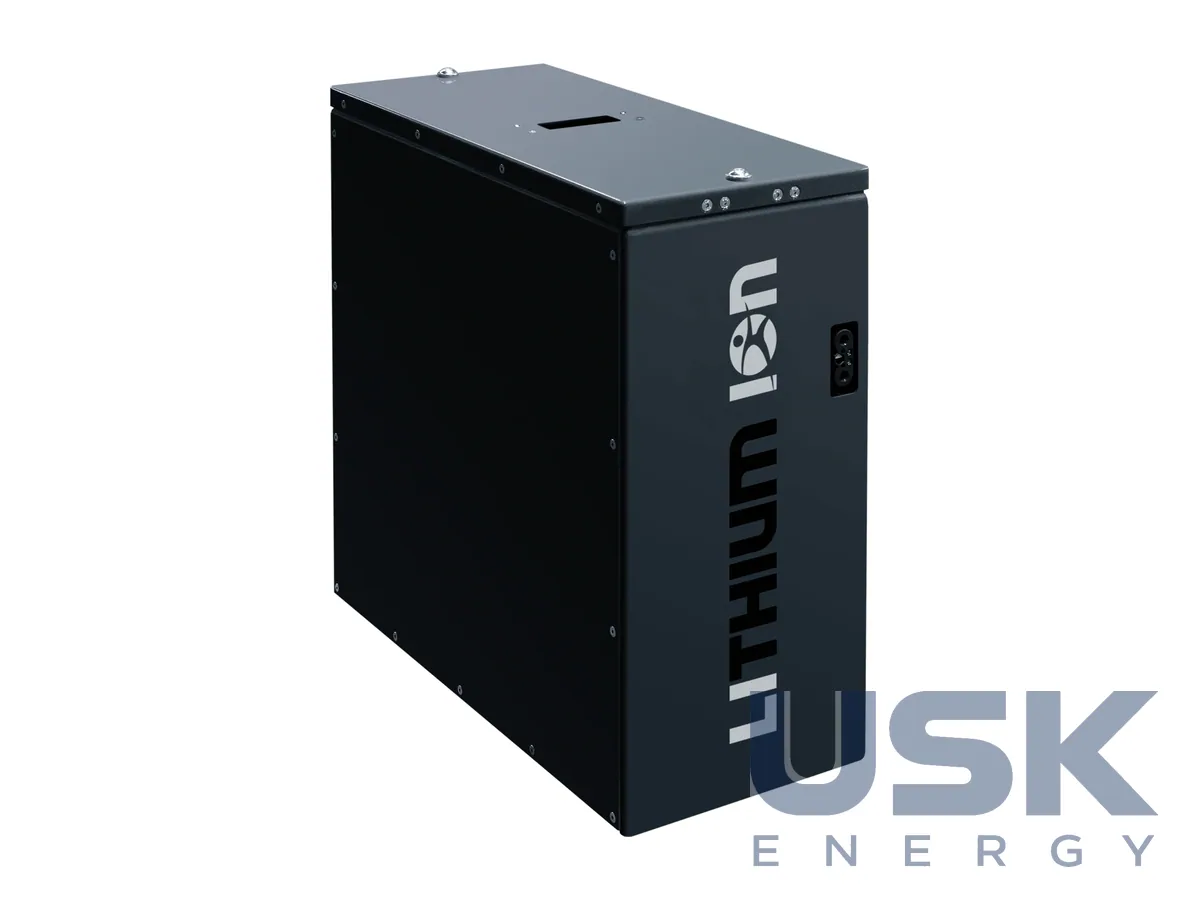
TRIATHLON — lithium-ion on-board batteries for rolling stock 24–120 V
Country: Germany · Model: TRIATHLON
TRIATHLON series on-board lithium-ion batteries with a nominal voltage from 24 to 120 V and an energy capacity of 1.9–190 kWh, built on LFP, LTO or NMC cells. They are designed for a specific train, locomotive or railway car to power the on-board network, start the diesel engine and provide intermediate energy storage for traction.
- Cell chemistry
- LFP (3.2–3.3 V), LTO (2.3 V), NMC (3.6–3.7 V)
- Nominal voltage
- 24, 36, 48, 72, 80, 96, 108, 120 V
- Energy capacity
- 1.9–190 kWh
- Capacity
- from 74 to over 2000 Ah
Technical specifications
| Cell chemistry | LFP (3.2–3.3 V), LTO (2.3 V), NMC (3.6–3.7 V) |
|---|---|
| Nominal voltage | 24, 36, 48, 72, 80, 96, 108, 120 V |
| Energy capacity | 1.9–190 kWh |
| Capacity | from 74 to over 2000 Ah |
| Charge and discharge temperature | −28…+50 °C |
| Charge factor | < 1.03 |
| Life (80 % DoD) | LFP — up to 4000, NMC — at least 6000, LTO — up to 30 000 cycles |
| Safety | container to EN 45545, safety software SIL 2, IEC 62928 requirements |
| Control | BMS, CAN link to fast charger, IoT monitoring |
Specifications are taken from the manufacturer’s technical documentation. Updated .
Description
The system is scaled by voltage and power; the available nominal values are 24, 36, 48, 72, 80, 96, 108 and 120 V, and the capacity ranges from 74 to over 2000 Ah. The cell chemistry is selected for the operating mode. LFP with a cell voltage of 3.2–3.3 V withstands up to 4000 cycles at 80 % DoD, NMC with 3.6–3.7 V gives at least 6000 cycles, and LTO with 2.3 V is designed for frequent fast charging and up to 30 000 cycles. Charging and discharging are permitted at −28…+50 °C, and a charge factor below 1.03 means minimal energy loss in a cycle. Cooling is by air, and the BMS monitors and protects the battery in all operating states. The container is made to the fire standard EN 45545, the safety software meets level SIL 2, and the system meets the requirements of IEC 62928.
How to choose
First determine the voltage of the on-board network, then the energy the battery must deliver per cycle, within 1.9–190 kWh. For diesel starting and buffering the on-board network with rare deep cycles, LFP is usually enough. Hybrid traction with constant regeneration performs better on LTO with a life of up to 30 000 cycles, and NMC gives the most energy per unit of mass. If the railway car project provides for classic chemistry, look at the rolling-stock nickel-cadmium batteries of 10–1500 Ah or the lead-acid PzS, PzV and monoblocks at 7–1500 Ah.
Request a price and lead time
TRIATHLON — lithium-ion on-board batteries for rolling stock 24–120 V. We reply within one business day.
Or email office@usk.ua or call +38 (044) 339-50-20.
FAQ
What nominal voltages do the TRIATHLON batteries have?
The battery is assembled for 24, 36, 48, 72, 80, 96, 108 or 120 V to suit the on-board network of a specific vehicle.
How many cycles do LFP, NMC and LTO cells withstand in an on-board battery?
At 80 % DoD, LFP cells withstand up to 4000 cycles, NMC at least 6000, LTO up to 30 000 cycles.
In what temperature range can the on-board lithium-ion battery be charged?
From −28 to +50 °C; the battery is air-cooled, and the BMS monitors the temperature state.
Which safety standards does the lithium-ion battery for rolling stock comply with?
The container complies with the railway fire standard EN 45545, the safety software has level SIL 2, and the battery is built to IEC 62928.
Does the on-board battery support communication with the charger over CAN?
Yes, the BMS exchanges data with the fast charger over CAN, and the battery state is visible in the IoT monitoring system.
Similar products
REQUEST
Need a price, lead time or replacement?
Send us a request and we will confirm the configuration, lead time and delivery terms. We reply by email.