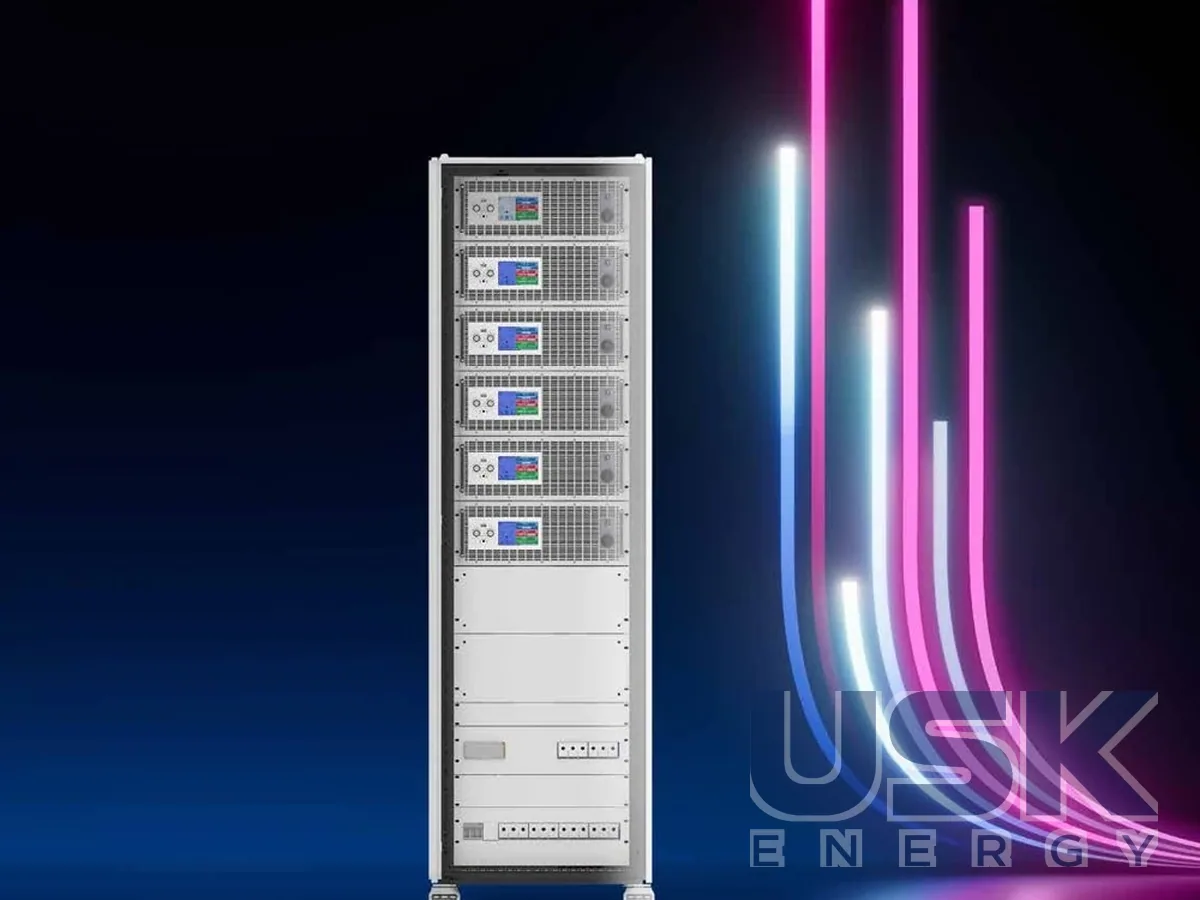
EA BPTS 20920-720 — battery pack test system 180 kW
Country: Germany · Model: BPTS 20920-720
The BPTS 20920-720 rack tester charges and discharges high-voltage battery packs with a power of up to 180 kW at 0–920 V and 0–720 A. Discharge energy returns to the grid with an efficiency of up to 96,5 %, so the test does not turn into a heater. The tester is used in laboratories that check packs for electric vehicles and energy storage systems (BESS).
- Power
- 180 kW
- Voltage
- 0–920 V
- Current
- 0–720 A
- Channels
- 1
Technical specifications
| Power | 180 kW |
|---|---|
| Voltage | 0–920 V |
| Current | 0–720 A |
| Channels | 1 |
| Regeneration | efficiency up to 96,5 % |
| Version | 42U rack, 3-phase 400 V 50 Hz |
| Command and measurement speed | up to 1 ms |
| Protections | built-in DC contactors, active pre-charge, polarity monitoring, dual-channel fast stop |
Specifications are taken from the manufacturer’s technical documentation. Updated .
Description
All the equipment is assembled in one 42U rack with a 3-phase 400 V 50 Hz supply, and there is one channel for the whole pack. Commands are executed and measurements are updated at intervals of up to 1 ms, which is enough for profiles with short current pulses. Before the pack is connected, the system performs an active pre-charge, so there is no current surge when the contactors close. Built-in DC contactors disconnect the pack from the tester, and polarity monitoring prevents connecting it the wrong way round. The dual-channel fast stop breaks the circuit in case of an emergency. Regeneration with an efficiency of up to 96,5 % reduces the load on the laboratory ventilation during long discharge cycles.
How to choose
The deciding parameters here are the pack voltage and the discharge power. BPTS 20920-720 covers packs up to 920 V and 180 kW in one channel. For individual modules up to 200 V, BMTS 20200-840-2 with two 60 kW channels is more cost-effective, and the 18-channel BCTS 20010-600-18 is intended for cells up to 10 V. If you need more than 180 kW or a voltage up to 1000 V, look at the ELR 21000 system with a power of up to 1920 kW.
Request a price and lead time
EA BPTS 20920-720 — battery pack test system 180 kW. We reply within one business day.
Or email office@usk.ua or call +38 (044) 339-50-20.
FAQ
What maximum battery pack voltage does BPTS 20920-720 support?
The voltage range is 0–920 V at a current of up to 720 A and a power of up to 180 kW.
How much energy does BPTS return to the grid during discharge?
Regeneration works with an efficiency of up to 96,5 %, that is, almost all the discharge energy goes back to the 400 V grid.
What protections are built into the BPTS battery pack tester?
DC contactors, active pre-charge, polarity monitoring and a dual-channel fast stop.
How fast does BPTS 20920-720 execute commands and measurements?
The command and measurement cycle is up to 1 ms, which is enough for dynamic charge and discharge profiles.
What power supply does BPTS 20920-720 need?
A three-phase 400 V 50 Hz grid; the equipment is supplied in a 42U rack.
Similar products
REQUEST
Need a price, lead time or replacement?
Send us a request and we will confirm the configuration, lead time and delivery terms. We reply by email.